
13 Mar Vela: The True Scale of a Hidden Giant Structure Revealed
Vela: The True Scale of a Hidden Giant Structure Revealed
Astronomers have uncovered a massive hidden structure in the Universe that had remained concealed behind the dust and stars of our own Milky Way galaxy. Using a new hybrid technique that combines different kinds of galaxy measurements, an international team has revealed the true scale of the Vela Supercluster, one of the largest concentrations of matter in the nearby cosmos.
The discovery fills a major gap in our map of the Universe and helps explain how galaxies move under the influence of gravity across enormous cosmic distances.
The “Zone of Avoidance”
About 20% of the sky is difficult to observe because it lies behind the dense disk of the Milky Way. This region, known as the Zone of Avoidance, hides distant galaxies behind thick clouds of dust and billions of foreground stars.
For decades, this blind spot has prevented astronomers from obtaining a complete picture of the large-scale structure of the Universe. As a result, scientists have struggled to fully understand the origin of the large cosmic flows – the large-scale motions of galaxies caused by the gravitational pull of massive structures.
A New Way to Map the Hidden Universe
To overcome this obstacle, the researchers developed a new hybrid reconstruction technique that combines two types of galaxy measurements:
- Galaxy redshifts, revealing how fast galaxies are moving away from us as the Universe expands.
- Galaxy distances and peculiar velocities, revealing how galaxies move under gravity across enormous cosmic distances.
By combining these measurements, scientists can reconstruct the underlying distribution of mass, including invisible dark matter.
The team used more than 65,000 galaxy distance measurements from the Cosmic Flows catalogue and added over 8,000 new galaxy redshifts observed close to the plane of the Milky Way.
A key breakthrough came from optical observations with the Southern African Large Telescope (SALT) and the MeerKAT radio telescope in South Africa, one of the most powerful radio arrays in the world. MeerKAT was able to detect galaxies deep inside the most obscured region of the Zone of Avoidance by observing hydrogen gas at radio wavelengths that pass through dust.
Prof. Renée C. Kraan-Korteweg said, “In the very early days, we used the 1.9m spectrograph of the South African Astronomical Observatory to get redshifts in the ZOA. The use of the Sutherland telescopes intensified in 2005. Later, the same instrument measured redshifts in the Vela region for MSc student projects.” On various occasions, the 1.9m telescope data filled redshift gaps along the southern ZOA of a whole-sky 2MASS redshift survey and trained numerous 3rd year undergraduate students during their semester break. In the early days, SALT found valuable hints of clusters at the Vela SCL redshifts.
For the first time, astronomers were able to probe this hidden region of the sky, she added.
The True Size of the Vela Supercluster
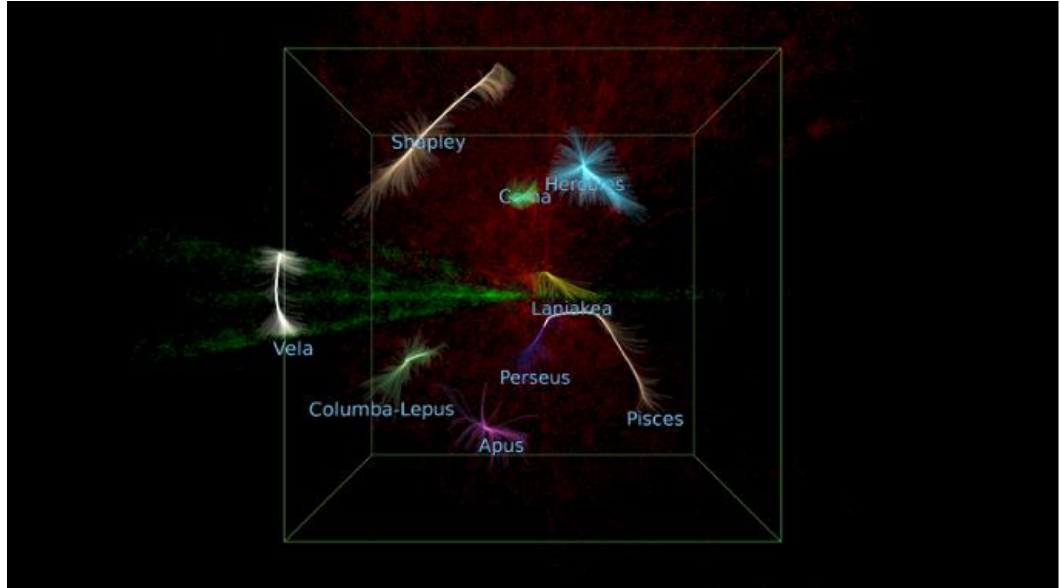
These new observations reveal that the Vela Supercluster is far larger and more massive than previously thought. Located roughly 800 million light-years away, the structure stretches across about 300 million light-years and contains an enormous amount of matter – equivalent to about 30 million billion Suns (equivalent to about 3 × 10¹⁶ solar masses).
The analysis shows that Vela rivals the famous Shapley Supercluster, considered the most massive structure in the nearby Universe. Vela itself has a complex internal structure, with two main dense cores moving toward each other, making this cosmic structure even more remarkable. Its gravitational influence exceeds that of other well-known regions such as Laniakea, the supercluster that contains our own Galaxy, and the Great Attractor.
Understanding Cosmic Flows
Massive structures like Vela exert a powerful gravitational pull on surrounding galaxies, shaping the large-scale motions of matter in the Universe. By revealing the true extent of the Vela Supercluster, astronomers can now better understand the cosmic flows that affect the motion of galaxies across hundreds of millions of light-years.
A Preview of the Future of Cosmic Mapping
The study also demonstrates the power of combining different types of observations to reconstruct the structure of the Universe, even in regions that are difficult to observe directly.
Such hybrid techniques will become increasingly important with the next generation of astronomical surveys and observatories, which will allow astronomers to map the cosmic web with unprecedented precision – revealing the hidden architecture of the Universe.
“This discovery helps complete our map of the nearby Universe,” explains the research team. “For the first time, we can clearly see one of the major gravitational players hidden behind our own galaxy.”
An affectionate name for the Vela supercluster: “Vela-Banzi”
The team of astronomers express their acknowledgement and respect for the use of the land in South Africa and Australia on which the telescopes that were used are located, and the communities and custodians of these lands, in this context.
Given the importance of the SARAO MeerKAT data at the lowest latitude in this endeavour, they introduce a locally inspired affectionate name for the Vela supercluster, “Vela-Banzi”.
Derived from the isiXhosa language, meaning “revealing widely” – an apt description of a structure that is now emerging from behind the Milky Way as a very extended massive supercluster.
Information on the authors:
- Renée C. Kraan-Korteweg, Department of Astronomy, University of Cape Town, Private Bag X3, Rondebosch 7701, South Africa
- Amber Hollinger and Hélène Courtois, Université Claude Bernard Lyon 1, IUF, IP2I Lyon, 4 rue Enrico Fermi, 69622 Villeurbanne, France
- Jeremy Mould, Centre for Astrophysics & Supercomputing, Swinburne University, Hawthorn, VIC 3122, Australia and ARC Centre of Excellence for Dark Matter Particle Physics
- Sambatriniaina Rajohnson, INAF Osservatorio Astronomico di Cagliari, Via della Scienza 5, I-09047 Selargius, (CA), Italy (former UCT PhD student).
Contact Researchers:
France: amhollinger@uwaterloo.ca, helene.courtois@univ-lyon1.fr
South Africa: renee.kraan-korteweg@uct.ac.za
Australia: jmould@swin.edu.au
Italy: sambatriniaina.rajohnson@inaf.it
Prof. Renée C. Kraan-Korteweg would like to acknowledge all the students who have worked with her at UCT to learn more about the hidden large-scale structures in the so-called Zone of Avoidance, and the financial support from the NRF and SARAO towards their bursaries and this research.
The full paper entitled “Hidden Vela Supercluster Revealed by First Hybrid Redshift & Peculiar Velocity Reconstruction” can be found at this link